
When offloading becomes imprinting
We become what we follow

Our earliest caregivers shape who we become.
One of the godfathers of this idea was Konrad Lorenz, an Austrian zoologist who studied animal behavior. In 1935, he coined the term Prägung, or imprinting, while studying greylag geese who left their nests early. These hapless goslings found themselves following the first thing moving around them. In the case of Lorentz, that thing was him.
If you Google him, you’ll find plentiful photos of his geese following Lorenz around the countryside. Up a creek, across a field, and down a road, carefully placing their little webbed feet into the muddy footprints left by his boots.
Growing up, I had lots of caregivers whose steps I followed in. The most significant one was Gigi. Gigi started out as something like a nanny and eventually became part of our family (my mom literally took out a classified in the local paper seeking a “surrogate grandmother” for my sister and me).
Gigi and her dog, a temperamental Lhasa Apso named Teme (short for Temescal, the Oakland neighborhood where Gigi found her), picked us up from school in her giant Toyota camper van. It was filled with blankets and bags of consignment clothes that were alternately coming or going from her closet.
Sometimes I felt embarrassed by my huge and unwieldy ride home. But that van was our passport to Gigi’s world. While she drove us to piano lessons, she fed us sliced salami and breadsticks and talked to us about elaborate art projects and old San Francisco. She took us to the original Peet’s coffee shop in Berkeley (before it had scaled to airports nationwide) and introduced us to the wonder of brioches. She taught us to scour remnant boxes at the back of Poppy Fabric, picking out prints for costumes, pillows, and quilts we were learning to sew on her ancient Singer sewing machine. She and her husband, Art, took us blackberry picking and taught us how to make pie crust.
The way Gigi moved through the world—finding steals at thrift stores, cooking elaborate meals from scratch, rescuing wayward animals—all left a lasting imprint on who I’ve become, especially as a parent. At my best moments as a mom, I feel as if I’m giving my daughters a bit of the magic she gave me.
Offloading, stunting,…and imprinting?
In the age of AI, I think the idea of who—or what—we follow is taking on new meaning and urgency. If we rely on AI to do our work or give us advice, at what point do we start following its lead?
Cognitive offloading (outsourcing our thinking to AI) and cognitive stunting (failing to develop skills because AI can do them for us) are now well-documented risks. But there’s a third risk that deserves attention: imprinting. For example, researchers in the UK found that in a randomized controlled trial with a representative UK sample (N = 2,302), 75% of participants who had a 20-minute discussion with GPT-4o about health, careers, or relationships subsequently reported following its advice.
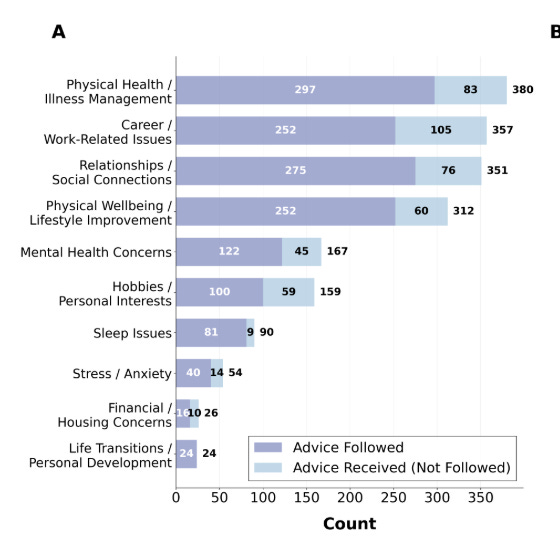
Source: Luettgau, et al., 2025
Advice may be take-it-or-leave-it, but leaning on AI for guidance may be a slippery slope toward blindly following its cues. In another study, Anthropic researchers analyzed 1.5 million consumer Claude conversations to detect potential or actual user “disempowerment” (i.e., creating or reinforcing users’ inaccurate beliefs about reality or urging users to adopt value judgments or actions misaligned to their own values).
The research found profound risks of disempowerment across various domains. Chief among them? Society, culture, and relationships. In other words, as people rely on AI for tasks and guidance, it’s not only reshaping what we can and can’t do, but what we believe about ourselves and how we interact with those around us.
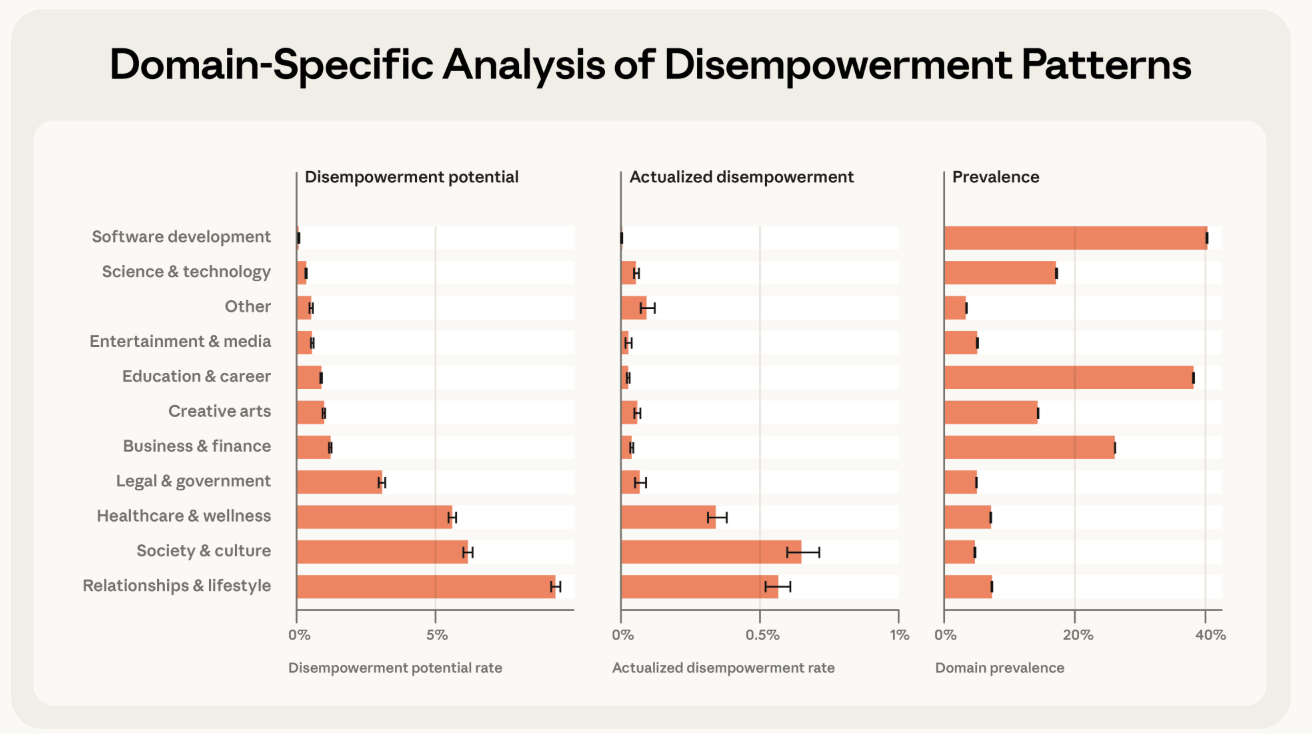
Source: Anthropic, 2026
These risks are arguably most acute for the most impressionable users. When it comes to young users—and to the least developed parts of adult users—leaning on AI could start to mean following it wherever it takes you.
Lending other leads to follow
How we describe what might be lost when people rely on AI is important, not only to determine risk, but to mitigate it.
Most suggestions about how to curb the risks of cognitive offloading point to cognitive solutions designed to make learning more rigorous in ways AI can’t touch. Solutions range from bans on AI in classrooms to project-based learning to reviving assessment techniques like blue books and oral exams.
Those are all laudable pedagogical fixes to reclaim cognitive development. But if offloading or stunting give way to imprinting, users don’t just need to be urged (or forced) to think for themselves. They also need role models—people to follow—who can show them the way.
In other words, the opposite of cognitive offloading might not just be thinking for yourself. It might be getting to see how other people think, having people who get in the hard work with you. The opposite of emotional offloading might not be handling your sh*t on your own, but watching how those around you manage relationships, or conflict, or communication. Reclaiming ourselves from the risks of AI may not be about going it alone, but doing more of it: learning, development, and connection…together.
While drafting this, I tried to think of what Gigi would make of AI. She died in 2014 and barely used technology. I couldn’t remember if she or Art ever even used email.
Turns out, according to my email archives, they did, only once. A week after my 28th birthday, and a year before Gigi died, Art sent me this note:
Our dear Julia.
I tried to respond to Face Books tip about your B-day last Wed.,but without
A mentor I couldn’t overcome a problem.
Gigi and I are so grateful to have been blessed to be part of your life.q
We wish you maximum happiness and a long life.
With much love,
Gigi and Art
Sent from my iPad
It reads like a postcard from the future we’re wending our way through—a reminder that technology can give us tips, but we all need mentors to follow.
This makes so much sense, Julia! It opens up important design questions for educators who want to create learning environments that counter cognitive offloading. I do circle based learning practices and your piece reminded me why, now more than ever, things like collaborative philosophical inquiry should be the norm and not an enrichment activity. Thank you!
This is such a salient point and beautifully written.